

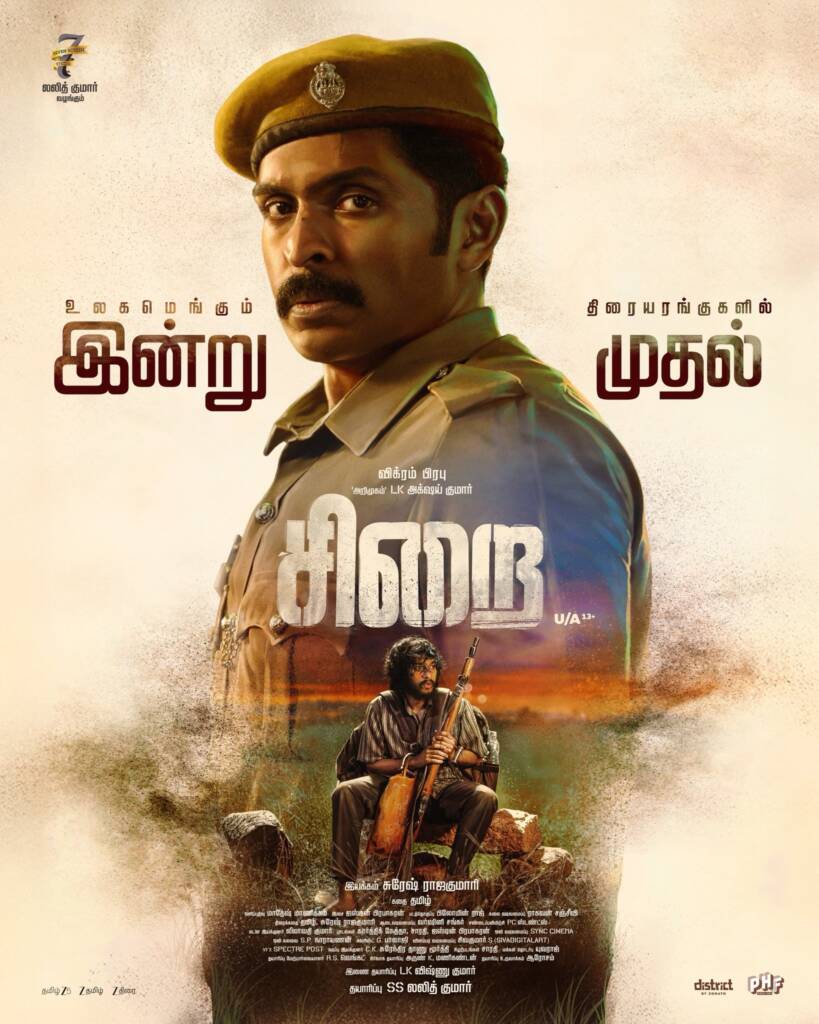
Introduction to Sirai Movie Review
A prison drama lives or dies by its ability to make the audience care—not about spectacle, but about people trapped inside an unforgiving system. This Sirai Movie Review takes a deep dive into a film that largely understands this principle. Sirai is a restrained, realism-driven Tamil drama that avoids cinematic excess for most of its runtime and instead focuses on everyday institutional cruelty. Anchored by a powerful yet understated performance from Vikram Prabhu, the film succeeds in making its point, even if it stumbles along the way.
Plot Overview: A Journey Through the System
Timeline and Setting (1997–2002)
Set between 1997 and 2002, Sirai unfolds during a period when bureaucracy, communal tension, and rigid hierarchies deeply shaped everyday life. The timeline is not just a backdrop—it quietly informs the film’s worldview, where justice moves slowly and empathy is often optional.
The Escort That Becomes a Moral Test
The story follows Constable Kathiravan, tasked with escorting Abdul, a prisoner, from Vellore jail to a court in Sivagangai. What seems like a routine transfer gradually becomes a window into systemic apathy. Crowded courtrooms, indifferent officials, and procedural delays turn human lives into paperwork. The journey becomes less about distance and more about endurance—physical, emotional, and moral.
Vikram Prabhu’s Performance: The Emotional Anchor
Understated Acting and Inner Conflict
Vikram Prabhu delivers one of his most mature performances to date. He resists the temptation to dramatize Kathiravan’s internal struggles. Instead, his emotions surface through silence, posture, and measured dialogue. This restraint makes his character believable and deeply relatable.
Kathiravan as a Symbol of Moral Resistance
Kathiravan lives by a simple principle: speak up or be crushed. In an environment where silence is rewarded and integrity is punished, his quiet defiance becomes revolutionary. His influence on others—without grand speeches—underscores the film’s belief that small acts of courage still matter.
Direction and Screenplay: Realism Over Spectacle
Procedural Authenticity
Director Suresh Rajakumari chooses sincerity over sensationalism. Police routines, escort protocols, and courtroom procedures are depicted with unpolished realism. These moments may not feel groundbreaking, but their honesty adds credibility to the narrative.
Where the Film Slips into Melodrama
Unfortunately, the film occasionally undermines its own restraint. Emotional beats are sometimes pushed too hard, relying on background score and familiar dramatic cues rather than organic storytelling. These moments feel out of sync with the otherwise grounded tone.
Characterization and Supporting Cast
Abdul’s Character Arc
Abdul, played by LK Akshay Kumar, is central to the narrative but not fully realized. While the performance is sincere, the writing limits his complexity. He often functions more as a symbol than a fully fleshed-out human being.
One-Dimensional Writing Issues
The film tells us to feel for Abdul rather than allowing us to discover him naturally. As a result, his emotional journey lacks nuance, making it harder to fully connect with his suffering.
Flashbacks and Narrative Weaknesses
Predictable Communal Conflict
The flashbacks detailing Abdul’s past are the film’s weakest link. A Muslim family in a Hindu-majority village, escalating communal tensions, and an abusive antagonist—these elements unfold exactly as expected. There is little narrative surprise.
Overused Tropes and Coincidences
Key events hinge on convenient coincidences, such as Abdul’s girlfriend being caught while attempting to elope. These plot devices dilute the emotional impact and make the conflicts feel manufactured rather than tragic.
Themes Explored in Sirai
Systemic Apathy and Institutional Decay
At its core, Sirai critiques institutions that normalize cruelty through routine. Delays, indifference, and rigid adherence to procedure slowly erode humanity, often without anyone explicitly acting as a villain.
Prejudice, Silence, and Complicity
The film highlights how prejudice operates quietly—through assumptions, silence, and passive complicity. Kathiravan’s refusal to conform exposes how rare moral courage truly is.
Technical Aspects: Cinematography, Music, Editing
The cinematography favors muted tones, reinforcing the film’s bleak emotional landscape. The music, while effective in parts, sometimes overreaches emotionally. Editing remains functional, though certain flashback sequences could have been tighter to maintain narrative momentum.
Emotional Impact vs Narrative Depth
Sirai often prioritizes emotional response over character development. While this approach succeeds in eliciting sympathy, it limits the film’s long-term impact. Strong emotions linger, but unanswered questions about character motivations remain.
Audience Reception and Critical Appeal
Audiences who appreciate slow-burn, realistic dramas will find much to admire. Those expecting layered character studies or narrative unpredictability may feel underwhelmed. Critics have largely praised Vikram Prabhu’s performance while noting the screenplay’s familiar patterns.